
Select Book Excerpts
By Rommy Faversham
Man o’War was one of the greatest Thoroughbred racehorses that ever lived. His owners, Samuel Riddle and Walter Jeffords shaped the future of horse breeding.
The book was published by the Russell Meerdink Company Ltd. in 2005. It is still available at Amazon and other retailers where books on horse racing and breeding are sold.
This will give you some key insights on the breeding of this iconic horse.
Chapter 5
The Price of Fame
What you want is fame? Then note the price:
All claim
To honor you must sacrifice.
Friedrich Nietzsche German philosopher and critic of culture 1844-1900
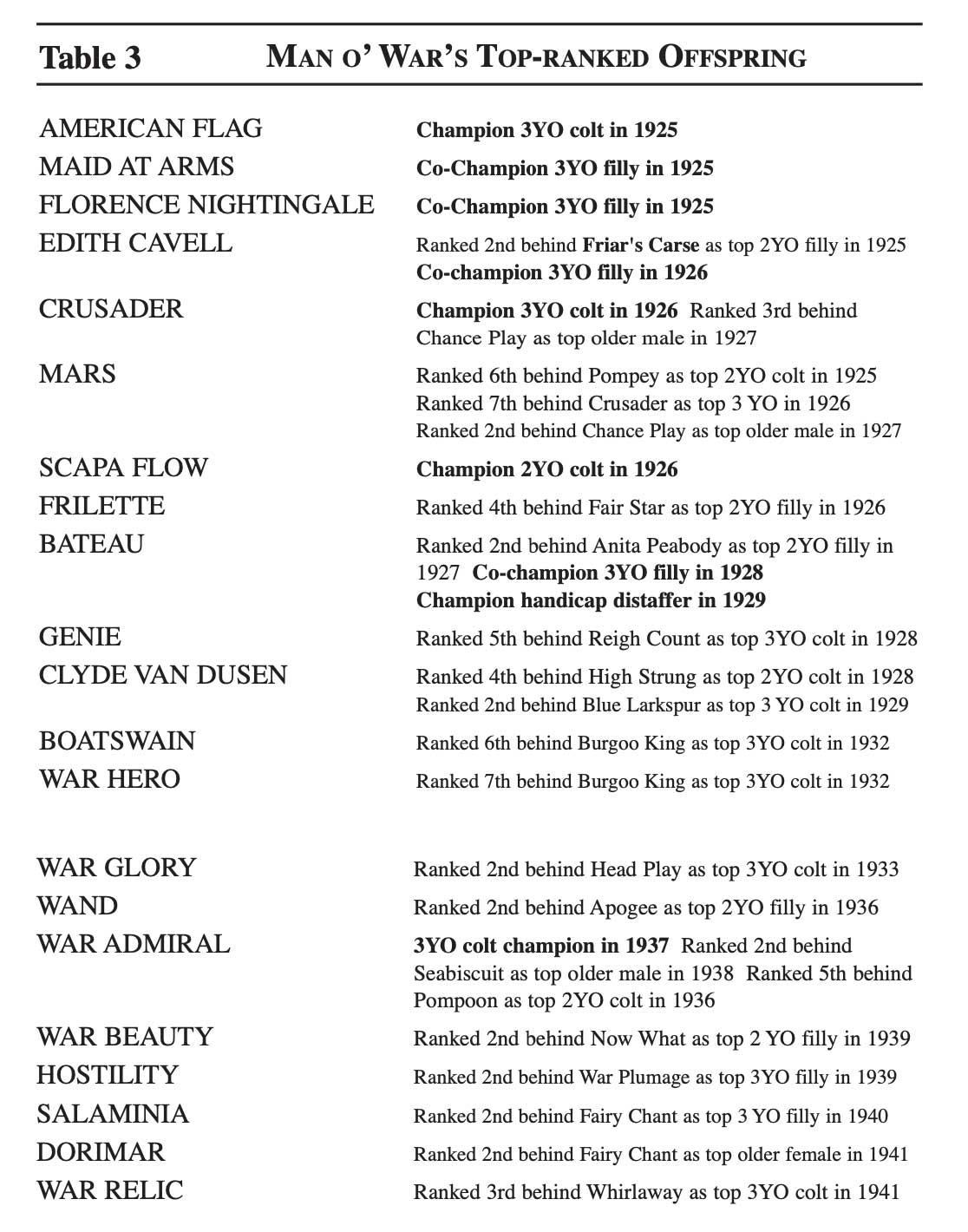
In 1942, Man o’ War, America’s most famous racehorse, surpassed his own sire, Fair Play, as racing’s richest stallion in terms of progeny earnings.
Now 25 years old and slowed by the infirmities of age, Man o’ War was bred to a small and, what turned out to be, final set of brood- mares earlier that year. Riddle officially retired him from stud duty the following season. The prospect of adding a few more quality years of life to the great chestnut was a far better option than risking further deterioration of the stallion’s health merely to secure a few more of his foals. Riddle often spoke of Man o’ War as a national treasure and his retirement from stud duty was rewarded with four and one-half more years of the superstar’s company.
Despite the apparent success and sentiment, no owner-breeder in the history of the American turf has ever absorbed as much public criticism for his management of a prominent stallion as did Samuel Riddle. In dozens of published accounts over the course of decades, Riddle’s handling of Man o’ War’s stud career has been vigorously questioned in some quarters and condemned in others.
Renowned Thoroughbred historian Abram S. Hewitt, who knew Riddle personally, saved some of his most biting remarks for the master of Glen Riddle Farm. In his 1977 book Sire Lines Hewitt wrote, “. . . records show that [Man o’ War’s] mates, by and large, were rubbish. Both their racing records and produce records were badly subnormal, and it is hard to say what Riddle was thinking of, if anything at all.” Making sure nobody missed him the first time, Hewitt continued to attack in his 1982 opus, The Great Breeders and their Methods, when he concluded, “Riddle had one of the worst collections of mares it would have been possible to put together!”
Other analysts, both before and after Hewitt, have generally been softer in tone, but the inference has always been the same: Riddle suppressed Man o’ War’s brilliance at stud by keeping him virtually as a private stallion while providing him with a small, lackluster collection of broodmares that were in no way worthy of the great sire.
Kent Hollingsworth wrote in The Blood-Horse’s Silver Anniversary Edition, “Man o’ War had little or no help from his mates and credit for his high percentage of stakes winners is all his. One can only speculate what Man o’ War’s record would have been had he been afforded the opportunity of being mated to better mares.”
Even Walter Farley’s warm and fuzzy semi-fictional Man o’ War from 1962, a book quite complimentary of Riddle as the horse’s owner, questioned his subsequent mating decisions.
As a result of all of this, many internet web sites dedicated to the Man o’ War saga share similar commentary, even though none of them provide any evidence to support the premise.
These opinions create a fascinating paradox. Why would Man o’ War’s owner, a man who once turned down a blank check for his colt, deny Big Red the best opportunities at stud? Furthermore, how much better was Man o’ War expected to perform? Despite the alleged mismanagement, his stallion career was characterized, by Riddle’s detractors themselves, as anywhere from superb to phenomenal. The more salient question is what precipitated all the criticisms? An exaggerated response is often more telling than the subject at hand.
For starters, it probably did not help that Sam Riddle was never the most popular horseman of his day. Seen as kind and cheerful to some, he came across as brash, even curmudgeonly, to others. Some just didn’t like his “salty talk.” Others, still, recalled a man who loved to offer up self-deprecatory humor while showing off his greatest prize to the throngs of Red’s annual visitors to Faraway.
Actually, the racing career of Man o’ War became a nerve-wracking ordeal for Riddle including death threats toward his horse and family and seemingly endless battles with an unrestrained and oftentimes ignorant or biased press. Riddle would often speak of the responsibility (burden) that came with owning Man o’ War.
It is also possible that some of the collective resentment directed toward Riddle was that it was not his genius that bred such an incredible animal. Hewitt recounts how at the end of WWI, Major Belmont returned from Europe and tried desperately to participate in his homebred’s man- agement, but to no avail. Man o’ War was Riddle’s horse.
More recently, Samuel Riddle has suffered the posthumous indignity of mischaracterization in a major motion picture when portrayed as the weak villain in the 2003 hit film Seabiscuit. Based on the best-selling 2001 non-fiction Seabiscuit: An American Legend by Laura Hillenbrand, the film’s script, written by director Gary Ross, was, for ‘enhanced story purposes,’ nowhere near as accurate.
The casting of corpulent, clean-shaven character actor Eddie Jones, a man in his early 60s, to play the medium-built, mustachioed Riddle in his mid-70s is the first sign of inattention to accuracy. The buildup to the great match race between Charles S. Howard’s Seabiscuit and Riddle’s War Admiral (described in the film to be 18 hands!) por- trayed the latter owner complete with dark shadows and insulting tones, ridiculing the West Coast horse while, at the same time, dodging any sort of contest with him.
Quite unsporting, actually, and completely untrue.
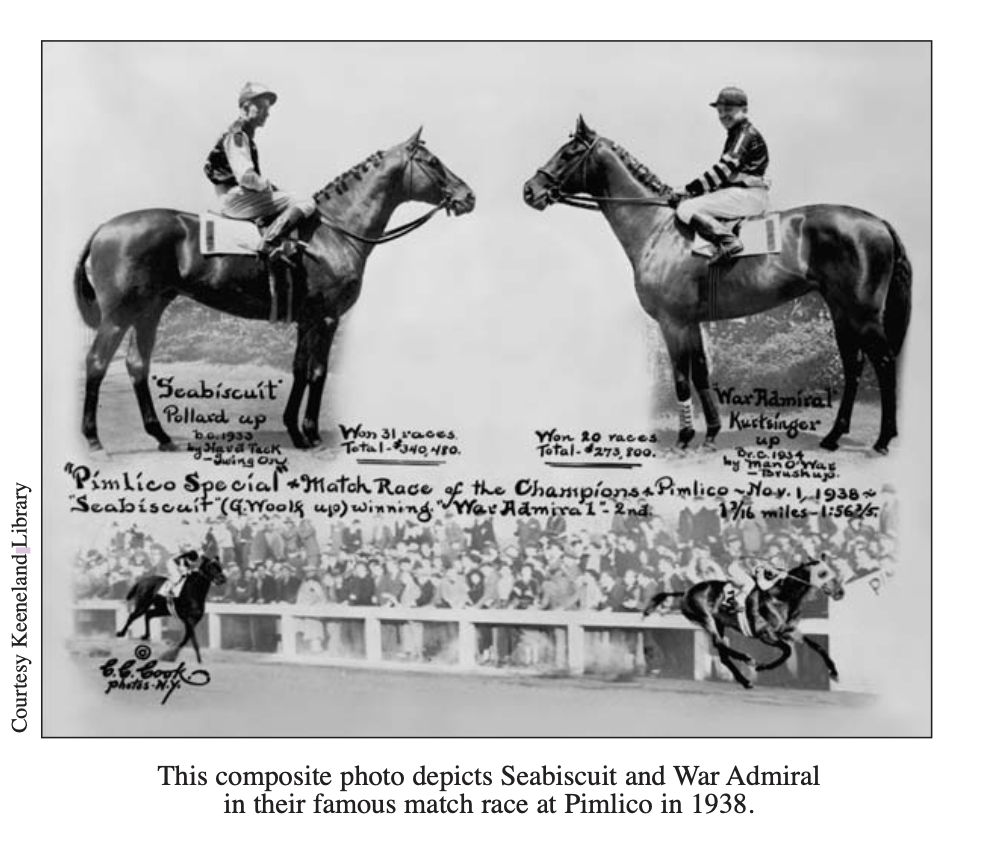
Hillenbrand’s book, less hungry for a villain, narrates much more accurately the events leading up to the historic meeting in the $15,000 Pimlico Special, on November 1, 1938, explaining the circumstances and gamesmanship both sides took part in.
The Ross script never alluded to Seabiscuit’s scheduled $100,000 match race against War Admiral, five months earlier, on Memorial Day at Belmont Park. When the Howard camp defaulted, claiming their champion’s knees were bothering him, the track pleaded with Riddle, sick in bed at the time, to run his colt in the Suburban Handicap to help save their weekend of racing. But, when War Admiral’s cautious trainer George Conway subsequently scratched the colt at 2 p.m. on the day of the race because of a questionable racing surface, there was hell to pay.
Esteemed turf historian John Hervey wrote, “an innocent bystander would have supposed [War Admiral’s scratch from the Suburban] was an unprecedented thing and a high crime and misde- meanor on the part of Glen Riddle Stable. Though Mr. Riddle was far from the scene of action and imprisoned in a sickroom, knowing nothing of what went on until it was all over, he was subjected to the most unseemly criticism, which in some instances was even venomous in its character.”
The film never mentions another scheduled engagement between the two headliners in the $50,000 Massachusetts Handicap at Suffolk Downs on June 29, 1938, which Seabiscuit also was scratched out of, this time at the very last minute. Riddle and Conway, probably petrified at that point, allowed their charge to stay in the race, despite the heavy rains. Like Seabiscuit, War Admiral was not a good mudder and ran fourth, the worst finish of his career.
Actually, going into their only meeting at Pimlico on November 1, 1938, Seabiscuit and War Admiral were eligible to meet on five different occasions and it was Seabiscuit each time that did not appear. As Hervey noted, “The Admiral was ready for the post and the older horse declined the combat.”
It is always possible Hollywood filmmaker Ross was blinded by an overriding agenda, as suggested by Philadelphia Daily News film critic Gary Thompson, who wryly noted Sam Riddle was, “played by a portly actor going for the Lionel Barrymore award for achievement in Robber Baron villainy . . . rare restraint [was shown] in not having [him] tie a damsel to a railroad track. He was an elitist. War Admiral was an elitist. Probably a Republican. Seabiscuit was a Populist, and he filled the grandstand and infield with huddled masses yearning to breathe free . . .”
To its credit, Seabiscuit does feature some very good perform- ances and excellent cinematography. This includes some of the most dazzling horse racing scenes in motion picture history, particularly those of Seabiscuit’s heroic four-length victory over the stunned Riddle colt.
In the aftermath of the “Race of the Century,” Hervey wrote, “the defeat of War Admiral by Seabiscuit was accepted by Mr. Riddle with a philosophic sportsmanship which few owners command. He offered no apologies, presented no explanation or attempt to minimize the reverse – but he did make the statement that he was ready and willing for another meeting between them.”
Riddle then moved War Admiral to Narragansett Park for the Rhode Island Handicap on November 18th for which Seabiscuit was eligible, with added money of up to $25,000 if both start. War Admiral won the race eased up while Howard kept The Biscuit in Maryland, passing up the last chance they would ever have to meet again.
It seems ironic – if not unfair – that Riddle, who did his best to thwart the entry of villains, contrived or real, into the Man o’ War story would, himself, be the victim of poetic license, saddled with the dark role of antagonist decades later.
Perhaps, all just part of the eternal price of fame.